
Autorin: Yvonne Heinen-Foudeh
What began with the shift towards vintage fashion – as a curated niche market – with the success stories of e-commerce platforms like e.g. Fashion Street, Re-see, Vintage Collective, and Vintage Vogue, all of which carry significant cultural and emotional weight, has now taken on new dimensions: “Pre-loved” is the name of the new reality, pointing the way: from a niche market to the new normal.

To know more and understand the dynamics of that trend the FT editorial team started an attempt towards quantification: from a variety of reliable sources and market studies here’s for an early stage result:
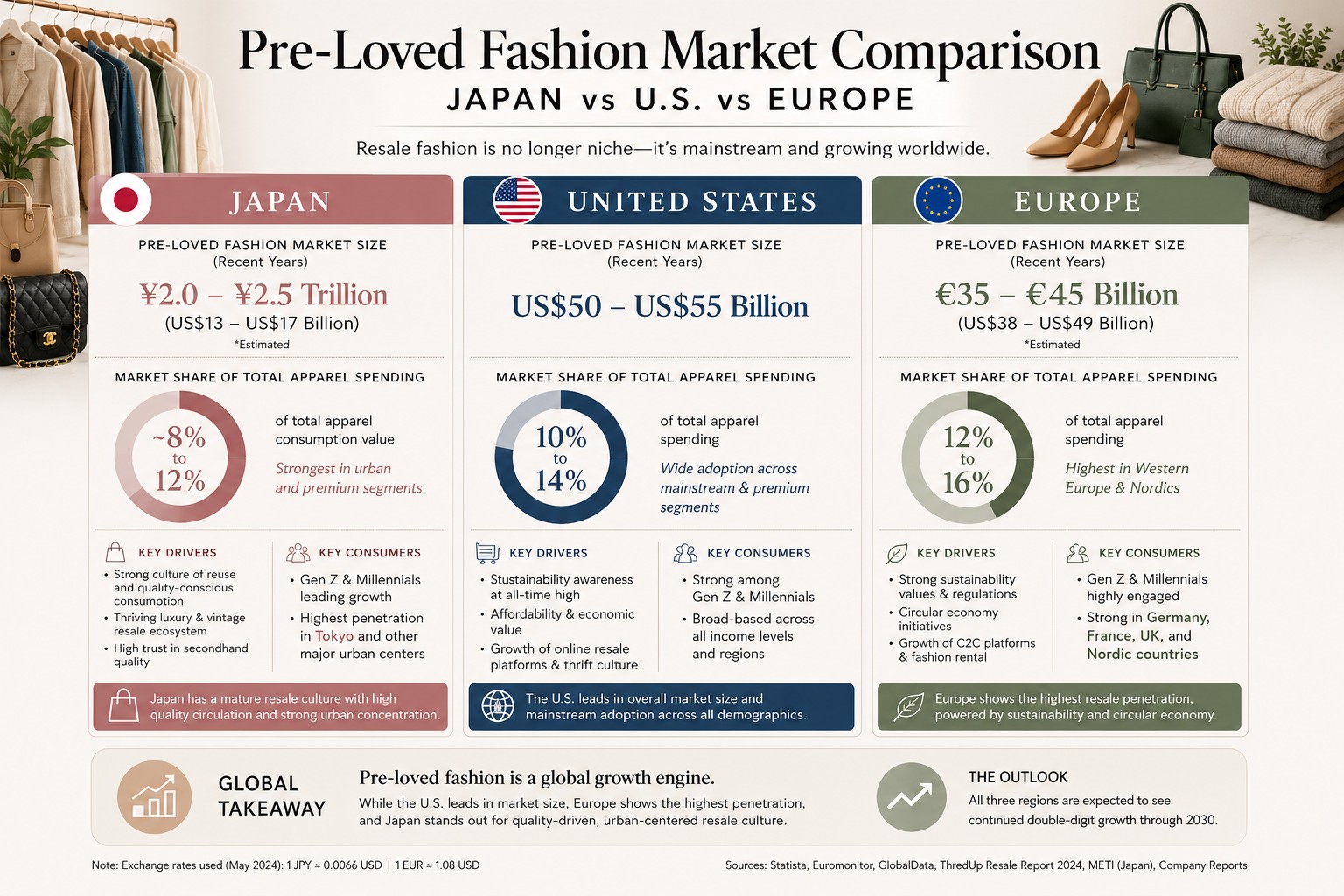
Throughout Europe we to date face some 12 to 16% sales ratio for “Pre-loved fashion” in total [s. graphic].
In the USA for comparison, resale apparel market lately reached roughly 50 to 55 billion US$ (Source: Forbes) in recent years. With that it represents about 10 to 14% of total U.S. apparel spending. Plus – pre-loved apparel sales grow a stunning four times faster than the overall apparel market.
While Asia as an overall market remains difficult to monitor in total in Japan as the most comparative market place according to FT investigation – pre-loved / resale clothing accounts for roughly ~8% to 12% of total apparel consumption value roughly 8 trillion JPY (~50 to 60Billon US$) range depending on year.
Some research firms and industry reports converge estimates even slightly higher in Gen Z segments, urban luxury resale (especially in Tokyo) and already existing curated vintage ecosystem in Japan. [For comparison also in regards consumer behavior in Europe – see graphic.]
Strategic responses to changing consumer behavior
As kind of a prime example let’s take a closer look to Zalando: the leading European technology platform for fashion and lifestyle, claiming to connect some 62 million active customers with more than 7,000 brands across 29 markets, it established the sales channel for “pre-owned fashion” as early as 2020 initially out of their Berlin headquarter in Germany and Spain. Just a few weeks later, the service was expanded to other European markets. In doing so, the European public limited company (legal entity SE) – as a smart for instance explicitly positioned „Pre-owned“ as a key component of a circular fashion economy in which clothing is used for longer.
Matter-of-factly millennials and the then-emerging Generation Z, in particular, are showing growing interest in secondhand fashion. Adopting “Pre-loved” essentially refers to used clothing for all age groups, regardless of whether it is particularly old, rare, or fashion-forward.
Although public pressure on the fashion industry has not yet reached the mass market, there is severe indication that consumer awareness is gradually increasing with regard to:
- Overproduction
- Textile waste
- CO₂ emissions
- (Ultra) Fast fashion
The reasons for that alarming, at the very least noteworthy development certainly are multi-folded. That said we can assume consciousness for more sustainable fashion consumption to certainly play an essential role given the growing volume for the pre-loved segment: Unmistakable signals from the end users, our actual customers are in the air: An avenue the market follows here to be viewed positively towards the end of the road.
Opportunity EU Eco Design Regulation (ESPR)
along those facts clearly indicates a promising approach displaying the way towards a strategic opportunity to communicate with consumers, providing tailored information about product care, repair ability, as well as the options for recycling. Improving traceability and transparency across the value chain will strengthen consumer trust and loyalty.
The mantra: Digital transformation plus cross-border collaboration
And yes, the Digital Product Pass represents yet another challenge to fashion industry and retail [compare i.e. FASHION TODAY editions 3-26] and back in 8-25]– yet as well an incentive to the global apparel community to a.) reinforce collaboration among all stakeholders on a global basis – against possible obstacles. And b.) should DPP be considered as an additional driver to leverage all technology tools actually at our finger tips to make the shift happen – to define data strategies, to assure transparency, and to map supply chains.